
Collaborative Workshop Champions Support for Neurodivergent Students on Placement

A 'World Café' format was used to generate in-depth discussion and ideas.
In April 2026, 30 educators from a broad spectrum of School of Medicine placement providers came together on campus for an innovative workshop focused on Supporting Neurodivergent Students to Thrive on Placement.
The session was the result of a highly collaborative effort, bringing together nine staff members from across disciplines. Importantly, four School of Medicine students were also consulted in the development of workshop materials, helping to ensure that the student personas and drop-in scenarios used during the session were authentic, realistic and grounded in lived experience.
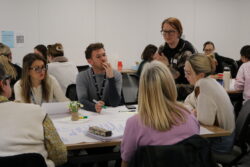
Professor Bridgette Bewick engaging in discussion with participants
The workshop used the World Café method, enabling participants to engage in structured, rotating small-group discussions. This approach proved highly effective in generating rich, in-depth conversations and shared insights across diverse professional perspectives.
Discussions across five tables explored a range of student experiences in placement settings. Despite differing scenarios, several consistent themes emerged:
- Inclusion is integral, not additional
Participants emphasised that inclusion is not something “extra”, but is embedded in how learning is structured, expectations are communicated, and time is managed. Simple, consistent practices - such as working step-by-step, clarifying expectations, and allowing time to respond - were seen as fundamental to effective learning.
- Relationships are central to inclusion
Open conversations, trust, and psychological safety were identified as essential. Participants recognised that students may hesitate to speak up or may worry about how they are perceived, highlighting the importance of proactive check-ins and creating space for dialogue.
- ‘Struggle’ often reflects cumulative load
Rather than focusing on perceived deficits, discussions reframed challenges in terms of cognitive, sensory, and emotional load. This shift encouraged participants to consider what students are being asked to manage within complex environments.
- The placement environment matters
Clinical settings - including noise, pace, interruptions, and unpredictability - were recognised as actively shaping students’ ability to concentrate, communicate, and build confidence.
- Small changes can have significant impact
Everyday actions - such as clarifying expectations, allowing pauses, and giving feedback privately - were recognised as simple but powerful ways to support students.
- Proactive planning improves experiences
Conversations highlighted the value of early discussions, anticipating challenges, and agreeing strategies in advance, benefiting both students and educators.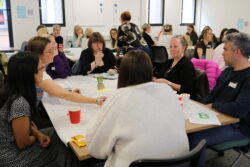
Table discussions were lead by table hosts
A key outcome of the workshop is a set of practical resources designed to support educators in applying inclusive approaches in placement settings. These include:
- Workshop materials and presentation
- A synthesis of discussion insights
- Student personas and scenario-based resources
These outputs are being shared with the wider University of Leeds education community, with the aim of supporting broader adoption of inclusive practices across clinical placement environments.
A model for collaborative innovation
The success of the workshop highlights the value of co-creation - bringing together educators, students, and interdisciplinary teams to address complex challenges in education. The use of the World Café method also demonstrated the potential for structured, participatory approaches to generate meaningful dialogue and practical solutions.
Participants reported leaving the workshop feeling inspired, motivated and empowered, with many also describing increased enthusiasm, confidence, energy and a strong sense of positivity and reflection about their practice.
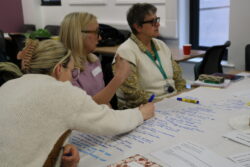
Participants were educators from across a range of School of Medicine programmes
For more details of LIME's CPD programme for clinical educators, please contact Liz Fisher, Training and Development Manager at [email protected]